
Acids - proton donors
Base - proton acceptors
Alkali - a base that dissolves in water forming OH- ions
Qu 1-2 P135
The role of H+ in reactions of acids
A hydrogen ion is just a hydrogen atom that has lost an electron.
As hydrogen only has 1 electron this means that a hydrogen ion is just a proton.
H+ and proton mean the same.
In water the acid dissociates producing hydrogen ions / protons:
| HCl(g) | + | aq | g | H+(aq) | + | Cl-(aq) |
| H2SO4(l) | + | aq | g | H+(aq) | + | HSO4-(aq) |
Mono, di and tri - basic acids:
Acids are categorised on the number of acidic hydrogen's / protons they can release:
Monobasic: releases 1 proton
| HCl(aq) | + | aq | g | H+(aq) | + | Cl-(aq) |
Dibasic: releases 2 protons
| H2SO4(aq) | + | aq | g | H+(aq) | + | HSO4-(aq) |
| HSO4-(aq) | + | aq | D | H+(aq) | + | SO42-(aq) |
Tribasic: releases 3 protons
| H3PO4(aq) | + | aq | D | H+(aq) | + | H2PO4-(aq) |
| H2PO4-(aq) | + | aq | D | H+(aq) | + | HPO42-(aq) |
| HPO4-(aq) | + | aq | D | H+(aq) | + | PO43-(aq) |
Acid - base reactions:
Acids react with:
Carbonates
Bases (metal oxides)
Alkalis (metal hydroxides)
In every reaction the acid is neutralised and water is formed as part of the reaction.
Looking at the ionic equation we can see why water is formed in each case.
This means we have to remove the spectator ions
These are species that do not change from reactants to products (including the state symbols).
It doesn't matter whether the acid is strong or weak as acids will release more H+ ions as they are used up in the reaction LCP
Carbonates:
| Full: | 2HCl(aq) | + | CaCO3(s) | g | CaCl2(aq) | + | CO2(g) | + | H2O(l) | ||||
| Ions: | 2H+(aq) | + | 2Cl-(aq) | + | CaCO3(s) | g | Ca2+(aq) | + | 2Cl-(aq) | + | CO2(g) | + | H2O(l) |
| Ionic: | 2H+(aq) | + | CaCO3(s) | g | Ca2+(aq) | + | CO2(g) | + | H2O(l) | ||||
If the carbonate is in solution it simplifies further:
| Full: | 2HCl(aq) | + | CaCO3(aq) | g | CaCl2(aq) | + | CO2(g) | + | H2O(l) | ||||||
| Ions: | 2H+(aq) | + | 2Cl-(aq) | + | Ca2+(aq) | + | CO32-(aq) | g | Ca2+(aq) | + | 2Cl-(aq) | + | CO2(g) | + | H2O(l) |
| Ionic: | 2H+(aq) | + | CO32-(aq) | g | + | CO2(g) | + | H2O(l) | |||||||
Bases:
| Full: | 2HNO3(aq) | + | MgO(s) | g | Mg(NO3)2(aq) | + | H2O(l) | ||||
| Ions: | 2H+(aq) | + | 2NO3-(aq) | + | MgO(s) | g | Mg2+(aq) | + | 2NO3-(aq) | + | H2O(l) |
| Ionic: | 2H+(aq) | + | MgO(s) | g | Mg2+(aq) | + | H2O(l) | ||||
Alkalis:
| Full: | H2SO4(aq) | + | 2KOH(aq) | g | K2SO4(aq) | + | 2H2O(l) | ||||||
| Ions: | 2H+(aq) | + | SO42-(aq) | + | 2K+(aq) | + | 2OH-(aq) | g | 2K+(aq) | + | SO42-(aq) | + | 2H2O(l) |
| Ionic: | + | g | |||||||||||
Redox reactions of acids with metals:
These are not acid base reactions as water is not made, they are just REDOX reactions:
| Full: | 2HCl(aq) | + | Mg(s) | g | MgCl2(aq) | + | H2(g) | ||||||
| Ions: | 2H+(aq) | + | 2Cl-(aq) | + | Mg(s) | g | Mg2+(aq) | + | 2Cl-(aq) | + | H2(g) | ||
| Ionic: | 2H+(aq) | + | Mg(s) | g | Mg2+(aq) | + | H2(g) | ||||||
Qu 1 - 2 P137
Acids as proton donors:
Hydronium ions:
Aqueous acids donate their protons to water. This makes water a proton acceptor forming the hydronium ion / oxonium ion:
| HCl(aq) | + | H2O(l) | g | H3O+(aq) | + | Cl-(aq) |
|
hydronium ion | |||||
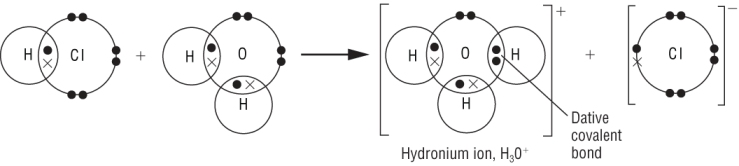
| HCl(aq) | g | H+(aq) | + | Cl-(aq) |
| hydronium ion |
Acid - base pairs:
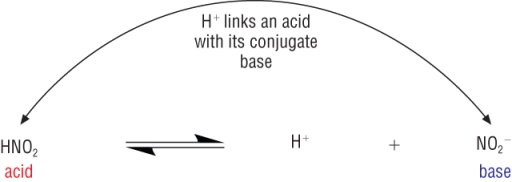
The forward reaction is when a proton is donated to water forming ions.
Strong acids fully dissociate meaning products predominate.
Now consider the reverse reaction.
The proton is now accepted by the NO2-.
This makes this an acid - base pair
Conjugate pairs
There is a relationship between 2 of the species, one on either side of the equilibrium and they can be considered conjugate pairs:
| Conjugate pair | ||||||
 |
||||||
| HNO2(aq) | + | H2O(l) | D | H3O+(aq) | + | NO2-(aq) |
| acid | base | acid | base | |||
 |
||||||
| Congugate pair | ||||||
Look at the NO2 species on both side of the equilibrium. They are in the acid and the base (an acid / base pairpairs.
Another Conjugate acid / base pair can be seen in the following reaction:
| Conjugate pair | ||||||
|
|
||||||
| NH3(aq) | + | H2O(l) | D | OH-(aq) | + | NH4+(aq) |
| base | acid | base | acid | |||
|
|
||||||
| Congugate pair | ||||||
Qu 1 - 2 P139
The pH scale

|
pH = -log10[H+(aq)] |
OR
|
[H+(aq)] = 10-pH |
What does pH mean:
| Low pH | High [H+(aq)] | |
| High pH | Low [H+(aq)] |
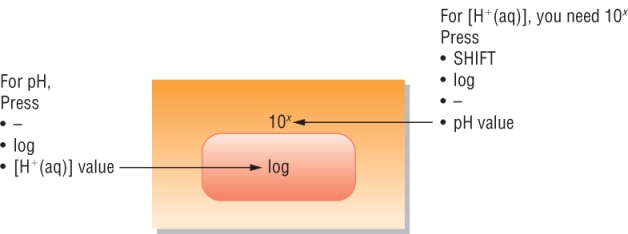
Converting between pH and [H+(aq)]
| Water | ||||
| HCl(g) | g | H+(aq) | + | Cl-(aq) |
| 1 mole | 1 mole | 1 mole |
Qu 1 - 3 P141
The ionisation of water and Kw
We always assume that water does not act as an acid or base in reactions.
Water plays a big part in the understanding of acids.
In order to understand acids then we need to understand water first:
Water: facts and models
Water conducts electricity. It has a conductivity of 26.6 x 10⁻⁶ Scm-1
The fact that water conducts at all means that there must be at least some ions present:
| H2O(l) | D | H+(aq) | + | OH-(aq) |
| Kc |
= |
[H+] x [OH-] |
| [H2O] | ||
| Kc x [H2O] |
= |
[H+] x [OH-] |
| Kc x [H2O] |
= |
[H+] x [OH-] |
| Kw |
= |
[H+] x [OH-] |
Kw has an equilibrium constant of 1 x 10-14
| Kw |
= |
[H+] x [OH-] |
| Kw |
= |
[H+] x [OH-] | = | 1 x 10-14 |
| [H+] | = | [OH-] |
| [H+] |
x |
[OH-] | = | 1 x 10-14 | |
| [H+]2 | = | 1 x 10-14 | |||
| [H+] | = | (1 x 10-14)0.5 |
where ( )0.5 = square root |
||
| [H+] | = | 1 x 10⁻⁷ |
|
pH = -log10[H+(aq)] |
| Kw |
= |
[H+] x [OH-] |
| Acidic conditions | [H+] > [OH-]. | Kw must always equal 1 x 10-14 | ||
| Alkaline conditions | [H+] < [OH-]. | [H+] x [OH-] = 1 x 10-14 | ||
The link between [H+] and [OH-]
The [H+] and [OH-].are linked by the ionic product of water.
| Kw |
= |
[H+] x [OH-] | = | 1 x 10-14 |
| pH | 1 | 3 | 5 | 7 | 9 | 11 | 13 | |
| [H+] | 10-1 | 10-3 | 10-5 | 10-7 | 10-9 | 10-11 | 10-13 | |
| [OH-] | 10-13 | 10-11 | 10-9 | 10-7 | 10-5 | 10-3 | 10-1 |
This means it is possible to calculate [H+] and hence pH from [OH-]
Qu 1 - 3 P147
| Water | ||||
| NaOH(s) | g | Na+(aq) | + | OH-(aq) |
| 1 mole | 1 mole | 1 mole |
| Kw |
= |
[H+] x [OH-] | = | 1 x 10-14 |
Example: 0.1M solution of NaOH
| [H+] |
x |
[OH-] | = | 1 x 10-14 | |
|
[H+] |
x |
0.1 | = | 1 x 10-14 | |
| [H+] | = | 1 x 10-14 | |||
| 0.1 | |||||
| [H+] | = | 1 x 10-13 | |||
| pH | = | -log10[H+(aq)] | |||
| pH | = | -log10[1 x 10-13] | |||
| pH | = | 13 |
There is a quicker way:
| [H+] |
x |
[OH-] | = | 1 x 10-14 | |
|
-log10 [H+] |
x |
-log10 [OH-] | = | -log10 (1 x 10-14) | |
|
pH |
+ |
pOH | = | 14 |
Qu 1 - 3 P149
Strong and weak acids, calculating the pH for weak acids
Acid - base equilibria:
Strong acids:
| Water | ||||
| HA(aq) | g | H+(aq) | + | Cl-(aq) |
Weak acids:
| Water | ||||
| HA(aq) | D | H+(aq) | + | Cl-(aq) |
| 1 mole | 0 moles | 0 moles |
| 0.99 moles | 0.01 moles | 0.01 moles |
| Water |
| CH3COOH(l) | D | H+(aq) | + | CH3COO-(aq) |
| 0.99 moles | 0.01 moles | 0.01 moles |
The acid dissociation constant, Ka
| CH3COOH(l) | D | H+(aq) | + | CH3COO-(aq) |
| Ka |
= |
[H+] x [CH3COO-] |
| [CH3COOH] |
Units of Ka
| Ka | = | [H+] x [CH3COO-] | ||||
| [CH3COOH] | ||||||
| Ka | = | mol dm-3 x mol dm-3 | ||||
| mol dm-3 | ||||||
| Ka | = |
mol dm-3 x |
||||
|
|
||||||
| Ka | = | mol dm-3 | ||||
| Large Ka | Large dissociation - Strong acid | |||||
| Small Ka | Small dissociation - Weak acid | |||||
Ka and pKa - a compressed scale:
| Ka |
= |
[H+] x [A-] |
| [HA] |
|
pKa = -log10[Ka] |
Calculating the pH for weak acids
| HA(aq) | D | H+(aq) | + | A-(aq) |
| 1M | 0M | 0M | ||
| 0.99M | 0.01M | 0.01M |
Step 1: [H+(aq)] must be calculated from the acid equilibrium expression, Ka:
| Ka |
= |
[H+] x [A-] |
| [HA] |
1) For a weak acid: [H+(aq)] = [A-(aq)] - as both have been formed from the dissociation of the acid.
2) [HA(aq)] remains unchanged - a weak acid dissociates so little that the concentration remains virtually the same.
| Ka |
= |
[H+]2 |
| [HA] |
| [H+]2 |
= |
Ka x [HA] |
| [H+] |
= |
(Ka x [HA])0.5 |
Step 2: [H+(aq)] is put in the pH formula: pH = -log10[H+(aq)]
Example: Calculate the pH of a 0.100 mol dm-3 ethanoic acid, Ka = 1.7 x 10⁻⁵ mol dm-3
| CH3COOH(l) | D | H+(aq) | + | CH3COO-(aq) |
Step 1: [H+(aq)] must be calculated from the acid equilibrium expression, Ka:
| Ka |
= |
[H+] x [CH3COO-] |
| [CH3COOH] |
1) [H+(aq)] = [CH3COO-]
2) [CH3COOH] remains unchanged
| Ka |
= |
[H+]2 |
| [CH3COOH] |
| 1.7 x 10⁻⁵ |
= |
[H+]2 |
| 0.100 |
| [H+]2 |
= |
1.7 x 10-5 x 0.100 |
| [H+] |
= |
1.304 x 10⁻³ mol dm-3 |
|
pH |
= -log10[H+(aq)] |
|
pH |
= -log10 [1.3 x 10⁻³] |
|
pH |
= 2.88 |
Summary:
Step 1: Calculate [H+(aq)]
| [H+] |
= |
(Ka x [HA])0.5 |
Applying assumptions:
1) [H+(aq)] = [A-(aq)]
2) [HA(aq)] remains unchanged
Step 2: Calculate pH
pH = -log10[H+(aq)]
Calculating Ka for weak acids
1) pH of the weak acid
2) Concentration of the weak acid
Step 1: Calculate [H+(aq)]
| [H+] |
= |
10 - pH |
Step 2: Calculate Ka
| Ka |
= |
[H+]2 |
| [HA] |
Example - Calculate Ka for 0.03 mol dm-3 methanoic acid, pH = 2.66
Step 1: Calculate [H+(aq)]
| [H+] |
= |
10 - pH |
| [H+] |
= |
10 - 2.66 |
| [H+] |
= |
2.19 x 10⁻³ |
Step 2: Calculate Ka
| Ka |
= |
[H+]2 |
| [HA] |
| Ka |
= |
[2.19 x 10⁻³]2 |
| [0.03] |
| Ka |
= |
1.6 x 10⁻⁴ Mol dm-3 |
Qu 1 - 3 P 143 / Qu 1 - 2 P145
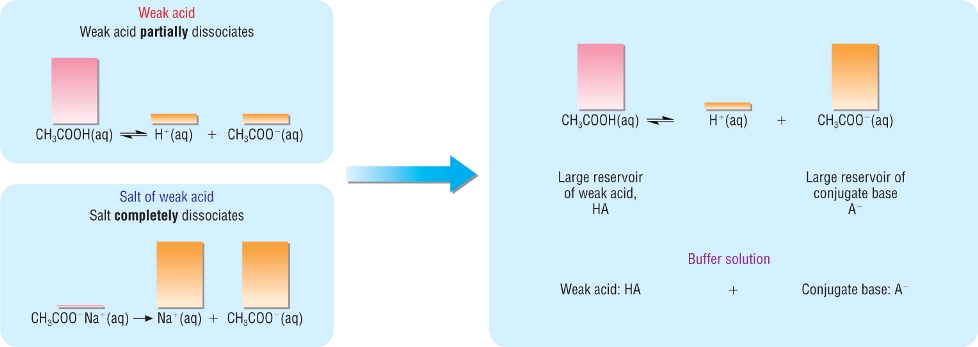
| A buffer solution minimises the change in pH with the small addition of acids or bases |
1) Weak acid, HA
2) Conjugate base of the weak acid, A-
| CH3COOH(aq) | D | H+(aq) | + | CH3COO-(aq) |
| CH3COO- Na+(aq) | g | Na+(aq) | + | CH3COO-(aq) |
| HCOOH(aq) | + | NaOH(aq) | g | HCOO- Na+(aq) | + | H2O |
| HCOOH(aq) | D | H+(aq) | + | HCOO-(aq) |
| HCOO- Na+(aq) | g | Na+(aq) | + | HCOO-(aq) |
How does a buffer act?
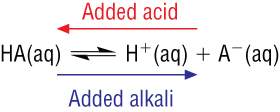
| HA(aq) | D | H+(aq) | + | A-(aq) | Reaction 1 |
| H+(aq) | + | OH-(aq) | g | H2O(l) | Reaction 2 |
Addition of and acid, H+ ions:
Addition of an alkali, OH- ions:
1) Ka of the weak acid
2) Equilibrium concentrations of the conjugate acid - base pair
Method 1:
1) Write the reaction:
| HA(aq) | D | H+(aq) | + | A-(aq) |
2) Write the equilibrium expression, Ka
| Ka |
= |
[H+] x [A-] |
| [HA] |
3) Rearrange the equation to calculate the hydrogen concentration
| [H+] |
= |
Ka x | [HA] |
| [A-] |
1) [HA] remains unchanged as it dissociates by such a small amount
2) [A-] = [NaA] as is dissociates fully
4) calculate the pH
|
pH |
= -log10[H+(aq)] |
Example:
1) Write the reaction:
| C2H5COOH(aq) | D | H+(aq) | + | C2H5COO-(aq) |
2) Write the equilibrium expression, Ka
| Ka |
= |
[H+] x [C2H5COO-] |
| [C2H5COOH] |
3) Rearrange the equation to get the hydrogen ion concentration:
| [H+] |
= |
Ka x | [C2H5COOH] |
| [C2H5COO-] |
| [H+] |
= |
1.3 x 10⁻⁵ x | 0.600 |
| 0.800 |
| [H+] |
= |
9.75 x 10⁻⁶ | |
6) calculate the pH
|
pH |
= -log10[H+(aq)] |
|
pH |
= -log10 [9.75 x 10⁻⁶] |
|
pH |
= 5.01 |
Method 2:

| pH |
= |
pKa |
+ log |
[A-] |
| [HA] |
| pH |
= |
- logKa |
+ log |
[C2H5COO-] |
| [C2H5COOH] |
| pH |
= |
- log 1.3 x 10⁻⁵ |
+ log |
[0.800] |
| [0.600] |
|
pH |
= |
5.01 |
The carbonic acid - hydrogen carbonate buffer system
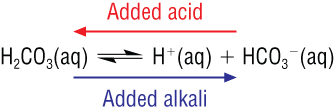
Carbonic acid: H2CO3 and its conjugate base: HCO3-
| H2CO3(aq) | D | H+(aq) | + | HCO3-(aq) | Reaction 1 |
| H+(aq) | + | OH-(aq) | g | H2O(l) | Reaction 2 |
Addition of and acid, H+ ions:
Addition of an alkali, OH- ions:
Overall:
| CO2(aq) | D | CO2(g) |

Qu 1,2 P153
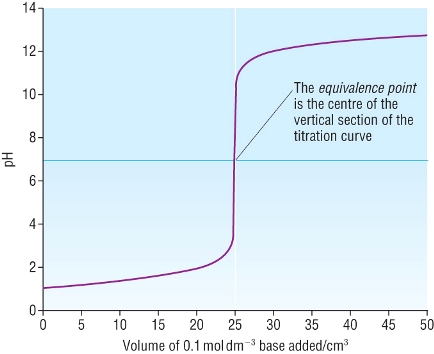
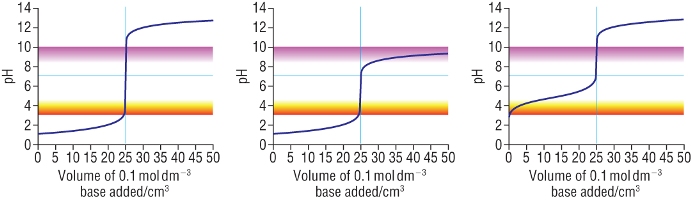
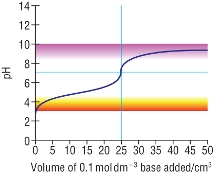
Neutralisation - titration curves
Titrations for AS chemistry
 |
|
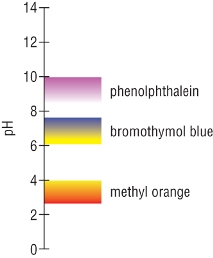
| HIn(aq) | D | H+(aq) | + | In-(aq) |
 |
|
 |
 |
||
| Strong acid – Strong base | Strong acid – Weak base | Weak acid – Strong base | Weak acid – Weak base |
| Phenylphthalein - Suitable | Phenylphthalein - Unsuitable | Phenylphthalein - Suitable | Phenylphthalein - Unsuitable |
| Methyl orange - Suitable | Methyl orange - Suitable | Methyl orange - Unsuitable | Methyl orange - Unsuitable |
Qu 1-2 P155
Neutralisation - enthalpy changes
| Full: | HCl(aq) | + | NaOH(aq) | g | NaCl(aq) | + | H2O(l) | ||||||
| Ions: | H+(aq) | + | Cl-(aq) | + | Na+(aq) | + | OH-(aq) | g | Na+(aq) | + | Cl-(aq) | + | H2O(l) |
| Ionic: | H+(aq) | + | OH-(aq) | g | H2O(l) | ||||||||
|
Is the energy change when aq acid is neutralised by aq base forming 1 mole of water under standard conditions |
Determination of enthalpy change of neutralisation:
Example:
25cm3 of 2M nitric acid is added to 25cm3 of 2M potassium hydroxide. The temperature increases from 22.0 oC to 35.5 oC.
Calculate the enthalpy change of neutralisation:
1) The energy change:
| Q | = | m | x | c | x | DT | |
| Q | = | 50 | x | 4.18 | x | 13.5 | |
| Q | = | 50 | x | 4.18 | x | 13.5 | |
| Q | = | 2821.5 Joules | Exothermic so will be negative: | ||||
| Q | = | - 2821.5 Joules | |||||
2) Calculate the number of moles used:
|
|
||||||||||||||||||||||||||||||||||||||||||||||||||||||||||||||||||||||
3) Calculate the amount of energy exchanged per mole of water, enthalpy change of neutralisation:
Enthalpy = Energy
Moles
Enthalpy = - 2821.5
0.0500
Enthalpy = - 56430 j Mol-1
Enthalpy = - 56.4 Kj Mol-1
The number of moles of acid : alkalil : water are the same for monobasic acids
Comparisons of enthalpy changes of neutralisation of different acids:
| Acid |
Reaction |
DHqneut / Kj Mol-1 |
||||||||||||||
| Hydrochloric acid |
|
- 57.9 | ||||||||||||||
| Nitric acid |
|
- 57.6 | ||||||||||||||
| Hydrobromic acid |
|
- 57.6 | ||||||||||||||
| Ethanoic acid |
|
- 57.1 |
Qu 1 - 2 P157 / Qu 6 - 9 P159 / 5 - 9 P163